Balance is for statues: Dynamic stability vs static symmetry
Demystifying perfect posture: why your spine needs movement variability and biological adaptability, not aesthetic stiffness.


If you have been dealing with persistent back pain, received a herniated disc diagnosis, or feel that fear of movement is holding you back from living your life, you are in the right place.
I am Cesar Santos, physiotherapist graduated from the ONCE University School of Physiotherapy (UAM), former Mountain Troops Captain, with a Master's in Musculoskeletal Manual Therapy and education in Clinical Psychoneuroimmunology (PNI) and Pilates. My methodology does not rely on indefinite passive treatments; instead, I apply Integrative Physiotherapy and medical pain neuroscience to help you understand your symptoms, dose progressive exercise, and regain your active autonomy.

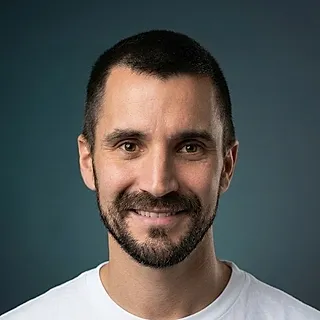
Physiotherapist · Master's in Orthopedic Manual Physical Therapy · Pilates & Clinical PNI
"What do you do when life turns out the lights overnight? You reinvent yourself to investigate how the human body adapts and empower others to regain control."
Physical pain rarely indicates irreversible damage. Identify your situation and discover what modern clinical evidence demonstrates.
Morning stiffness, sharp pain when bending over, or feeling "stuck". The lumbar spine is a robust biological structure engineered for movement, not immobilization.
Burning, tingling, or electrical shooting pain descending from the glute down the thigh and foot. We assess neurodynamic sensitivity and the functional root cause.
Were you told you have disc degeneration or a protrusion and now fear lifting weights? Science proves MRI images do not equate to a lifetime pain sentence.
Trapezius stiffness, restricted neck rotation, and tension headaches caused by long desk hours, static postures, and accumulated stress.
Pain lasting over 3 months that has not resolved with rest or medications. We evaluate nervous system hypersensitivity, lifestyle factors, and sleep quality.
Sharp pain when raising your arm (rotator cuff), Achilles tendon stiffness, or heel pain in the morning. Tendons adapt and rebuild through progressive load, not total rest.

Learn how your movement, sleep, immune system, and daily habits interconnect. Free of unnecessary jargon or unjustified fear about MRIs and posture.

Analysis on neurophysiological mechanisms of manual therapy, PNI approaches in complex musculoskeletal pathologies, therapeutic exercise, and praxis reflections.
Treating only the exact spot where it hurts usually leads to recurring pain. Integrative Health and Clinical Psychoneuroimmunology (PNI) look at the whole picture: how you move, how your nervous system responds, how you sleep, and which daily habits keep your pain alarm active.
Precise manual techniques to relieve acute pain and ease joint or muscular stiffness. Not a passive treatment to keep you coming back endlessly, but a starting point so your body regains confidence and can start moving comfortably.
Properly dosed movement is the best medicine available. We build progressive, tailored exercises to rebuild spinal strength, improve motor control, and prove to your body that it is far more resilient than you think.
Your pain does not exist in a vacuum. Poor sleep, chronic stress, or low-grade inflammation make your nervous system sound the pain alarm much faster. Through PNI, we fine-tune these key daily factors to ensure long-term relief.
Understanding your symptoms physically changes how much they hurt. We dismantle fears and myths around MRIs or fragile joints. When your brain recognizes that movement is safe, it naturally turns down the pain volume.
Click on any card to contrast common beliefs with scientific facts demonstrated by clinical research.
35% of people over 40 have herniated discs without feeling any pain (Varun S. et al., 2025). The image reflects normal age-related changes, like wrinkles on the skin, not a certificate of disability.
There is no single or perfect posture. Science shows no causal link between static postures and pain. The body needs movement and variability; your best posture is the next one.
Persistent pain is a hypersensitive alarm system. Pain protects before actual damage occurs. Graded, adapted movement trains the brain to regulate sensitivity.
Demystifying perfect posture: why your spine needs movement variability and biological adaptability, not aesthetic stiffness.
Discover the neurobiology of pain and how understanding how your nervous system works acts as a physical brake against pain.
Demystifying imaging findings: discover why herniations and spinal wear are normal as we grow older.